
Comfort Comes with a Body Count
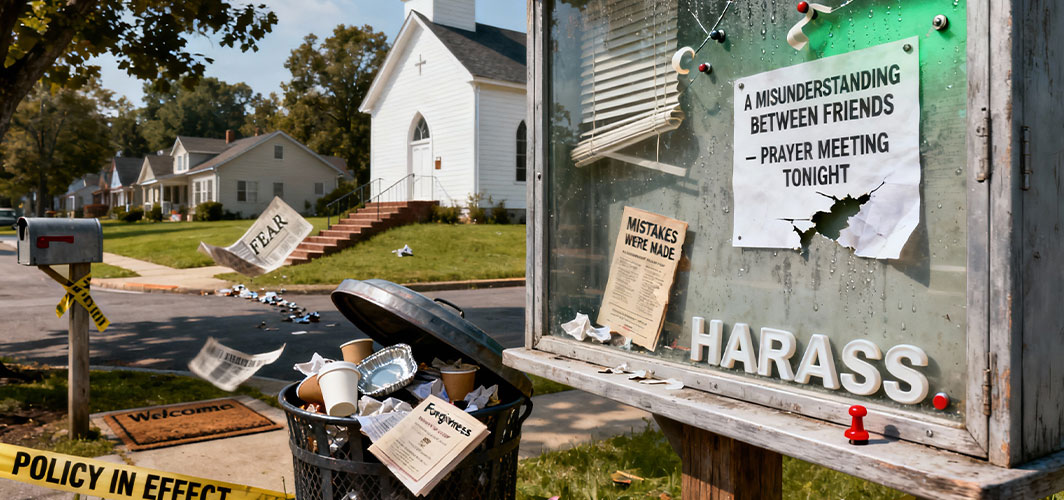
Small towns don’t forgive by weighing guilt and innocence. They forgive by deciding who belongs. If you grew up where the church parking lot doubles as a newsroom, you know the ritual: absolution often isn’t earned, it’s assigned quietly, like casting roles in a play the town won’t admit exists. The homecoming king gets “We all make mistakes.” The kid who never fit the mold gets “We’re praying for them.” Same sin, different verdict. That’s not sociology. That’s horror, not the jump-scare variety, but the slow, daylight kind that breathes under the floorboards while everyone upstairs insists the house is fine.
What chills isn’t the mask you can see, Jason’s hockey face, Michael Myers’ blankness, but the smiling committee that polishes it. In a courtroom we argue facts; in a cul-de-sac we massage comfort. Listen to the language and you can hear the monster feeding: “Something terrible happened, he’s a good kid.” “Thoughts and prayers.” The phrase slides off its subject until the wound belongs to no one. Passive voice becomes a tool of erasure. That’s daylight horror: the sentence loses its subject, and the wound loses its owner.
I remember a town where a teacher reported a minister’s son for harassment. Sunday’s announcement called it “a misunderstanding between friends.” A tray of casseroles appeared on his porch; the teacher’s mailbox filled with pamphlets about forgiveness. No one said “harassment” out loud. The town rewrote the sentence to protect a ritual: belonging before truth. The house learned who gets forgiven by tracking which tragedies earn casseroles and which earn silence. Architecture listens; communities remember the seats of power by who always gets the corner piece of cake.
When supernatural forces show up in stories, their job is rarely simple spectacle. A vampire in a polite suit isn’t merely a symbol of bigotry, it’s what bigotry becomes when no one names it. Ghosts aren’t the core problem. Amnesia is, and amnesia is contagious. Forgetting protects the ceremony. Performative forgiveness; “Let’s move on” tastes like water but guts like acid. True forgiveness would shatter the glass house; counterfeit forgiveness keeps the panes intact.
That’s why I linger at PTA meetings and town committees in my fiction. Procedural cruelty is horror’s quiet apex predator; it doesn’t hiss or growl, it smiles while it whispers behind closed doors. It fences off pain with “we have policies,” and calls the fence virtue. Scream-based scares run out of air. Systems endure. The long, daily mechanics of omission and euphemism are the slow plot of a small-town nightmare.
This isn’t just elegy; there’s a route out. Horror’s job, when it’s doing its best work, is to map the ecosystem: who cuts the cake, who always gets the corner slice, whose name disappears from the program. Heroes in this register are the librarian who leaves a banned book on the reshelving cart, the pastor who changes the prayer from “them” to “us,” the neighbour who writes the missing name back into the story, letter by letter. These are small acts, procedural reversals that refuse the passive voice.
Forgiveness isn’t forgetting. It’s remembering precisely so belonging can’t be bartered away. The scariest creature in the room often wears a name tag and smiles with a toothless grin. Once you see it, you can’t unsee it , and you absolutely shouldn’t. The task for writers and citizens alike is to keep the sentence honest: name the harm, name the perpetrator, hold the ritual accountable. When we do, the dark corners stop collecting excuses and start collecting consequences. That’s where horror does its cleanest work, not in the scream, but in the naming.

Dr. Todd Brown
Guest Ghoul
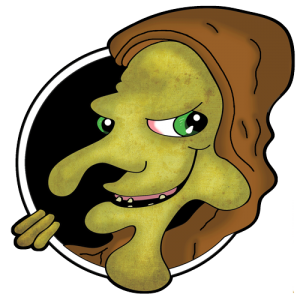
Hey Horror Fans - Welcome to suburbia’s sweetest SIN-namon roll, fresh from the bake sale of bad faith! Morti the Mortician here, SLICING into small-town “forgiveness” with my favourite stainless-steel cake knife.
This piece isn’t about jump scares; it’s about the slow-cook TERROR that marinates in cul-de-sacs, where the casserole comes hot and the truth gets served cold. So tell me, my graveyard gourmands: what’s your favourite daylight horror (film, episode, or game) that nails this polite cruelty? I’m thinking The Stepford Wives (1975) for cul-de-sac chills, The Wicker Man (1973) for ritual smiles, or Hot Fuzz (2007) for “the greater good” with a wink and a shiv. Got a sharper pick? STAKE it in the comments below. Until next time, ghouls, keep your cakes labelled, your bins overflowing, and your sentences armed with subjects. After all, in small towns, the scariest mask is the name tag.
Keep Rotten"
"Morti" The Mortician
(The Editor)
Recent Post


Follow Your Fear!
Special Features


Screams to Screens: Horror Legends in TV Commercials

Certainty Is The Monster: Why the Scariest House is Built by Your Own Mind

Rethinking The Terminator: How “John PRIME” Reshapes Sci-Fi’s Greatest Paradox

10 Creepy & Unsettling Websites Every Horror Fan Needs to Visit

American Horror Story 13: Returning Characters, Cast and Everything We Know So Far